01
The problem
An Indian apartment community runs on informal infrastructure. Maintenance dues are tracked in a spreadsheet on the treasurer's laptop. Visitors are logged in a paper register at the gate that nobody reads again. Notices go out on WhatsApp, where they scroll away by evening. When the committee changes hands each year, most of the institutional memory leaves with it.
The same residents, separately, are transacting property — buying, selling, renting — through brokers and classified sites that have no connection to the community they already live in, and no reliable answer to the one question that matters most in Indian real estate: is this project actually approved?
“Two problems, one set of people. Nobody had put them on the same platform.”
The design question was not "how do we build a society-management app" — several exist. It was how to make the daily-utility side (dues, gate, notices) valuable enough that the community stays, and then let the real-estate side benefit from an audience that is already verified as living somewhere real.
02
The ten things that carry the product
The system grew past fifty domain models, but a platform is not its model count. These are the ten capabilities that do the actual work — the ones a committee member or a buyer would notice if they disappeared.
- 01Association ledger — expenses, payments, per-unit dues and automatic late-fee accrual, so the treasurer's spreadsheet stops being the source of truth.
- 02Gate & visitor security — watchman-operated entry logging with resident pre-approval, turning the paper register into a searchable record.
- 03Resident onboarding by code — owners and tenants join their own community with an AptLok code, so the committee is not manually provisioning accounts.
- 04Role-aware access — committee, owner, tenant, watchman, agent, and admin each see a different application built from the same data.
- 05Unit and occupancy model — units, owners, tenants, family members, household staff, and vehicles, so the community knows who is actually resident.
- 06Notices and newsroom — announcements that persist and stay addressable, instead of scrolling out of a chat thread.
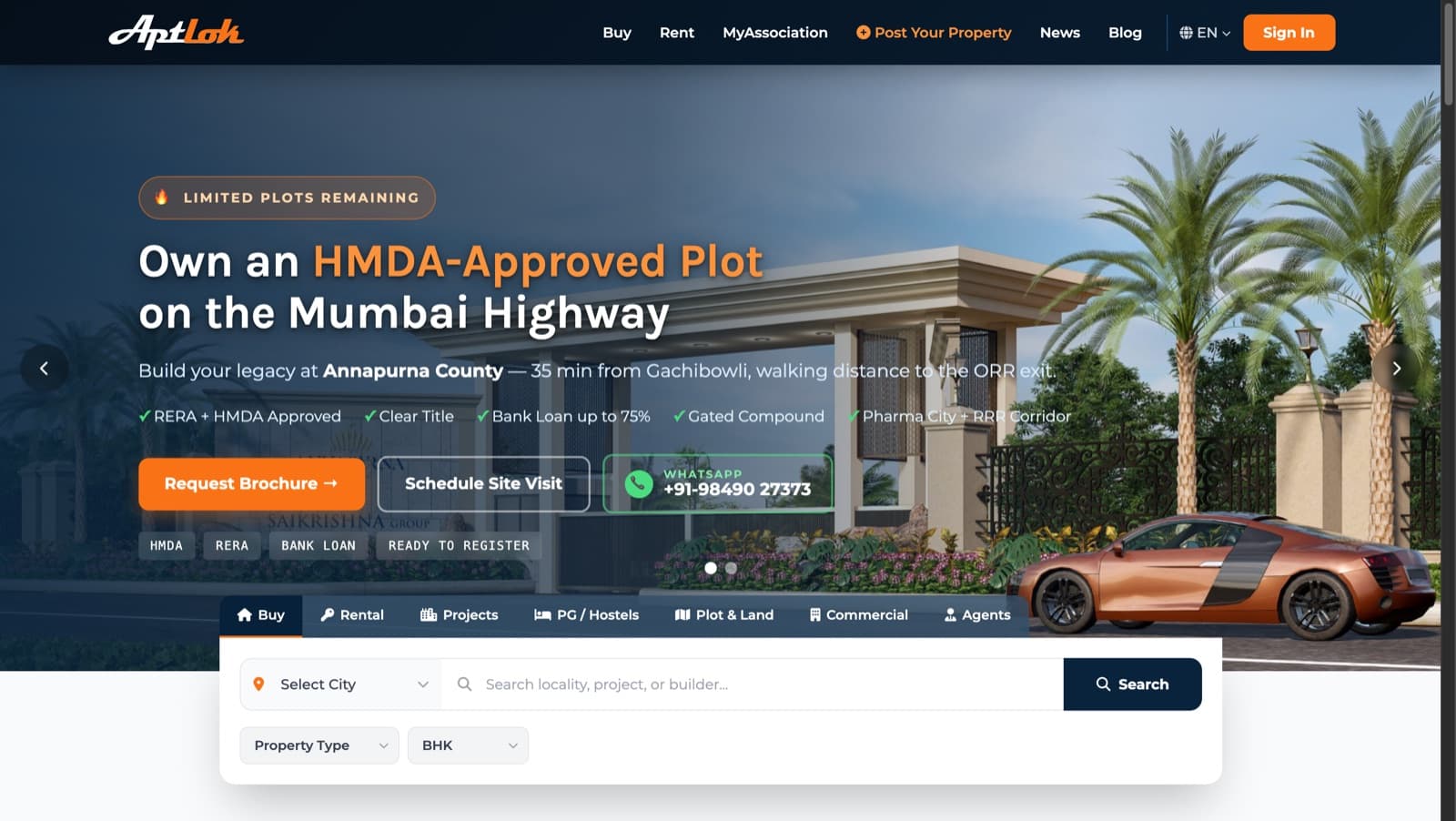
- 07Property marketplace — buy, rent, plots, commercial, PG/hostels and projects, with images, enquiries, and saved favourites.
- 08RERA-aware project data — a scraper pipeline that ingests regulator project records so listings can be checked against the public register.
- 09Locality advisory signals — zone, station and market-block data behind the listings, so a buyer sees context rather than only a price.
- 10Agent CRM — leads, follow-ups, activity history, agent ratings, and team invites for brokerages operating on the platform.
“Everything else in the schema exists to make these ten trustworthy.”
03
Architecture
Laravel 12 on PHP 8.2 with MySQL, Blade and Tailwind on the front, Sanctum for API tokens, and Socialite for Google sign-in on the web — chosen because the mobile client needed a token API and the web needed sessions, and one framework could serve both without a second backend.
Two front doors
The community modules assume an authenticated resident with a verified unit. The real-estate modules assume an anonymous visitor who may never sign in. They share models but not assumptions — a listing must render for a stranger, a ledger must not.
The RERA ingestion runs outside the application as a scheduled Python service with its own store, writing scraped project records the platform reads. Keeping it out of process meant a regulator site changing its markup could never take the platform down with it.
Decisions worth naming
- —Slug redirects were modelled explicitly, so listing URLs could change without breaking links already shared over WhatsApp.
- —Phone verification was separated from user identity — in this market a number is the real account, and it changes hands.
- —Push tokens were stored per device rather than per user, because a household shares one login across several phones.
- —Anonymous enquiry capture came before account creation; asking a buyer to register before they can ask a question loses the buyer.
04
Deployment
The platform runs on a VPS behind Nginx with Let's Encrypt TLS and an HTTP-to-HTTPS redirect, sharing the box with the scraper service and its own database. Deployment is a build-and-release step rather than a build-on-production step, so a failed build never leaves a half-updated site serving traffic.
Multilingual support was wired in at the template layer from the start rather than retrofitted — an English-only property platform in Hyderabad is a product that has decided who it is not for.
05
What it changes
- —The committee's records survive the committee. Handover stops being a folder of spreadsheets and a verbal briefing.
- —The gate produces a queryable history — who visited, when, approved by whom — rather than a register nobody reopens.
- —Dues chase themselves. Late fees accrue by rule instead of by an awkward conversation.
- —A buyer can check a project against the public regulator record on the same screen where they found it.
- —A brokerage gets a working CRM without buying one, and residents get listings from a platform that already knows the locality.
The platform is live at aptlok.com.